Sourcing fitness equipment from Chinese manufacturers begins with the exact equipment type, user setting, installation constraints, and performance and safety evidence required for the destination market. Buyers should compare model-specific data, review components and service support, plan delivery and installation, and connect inspection results to the serial or lot identifiers on the accepted order.
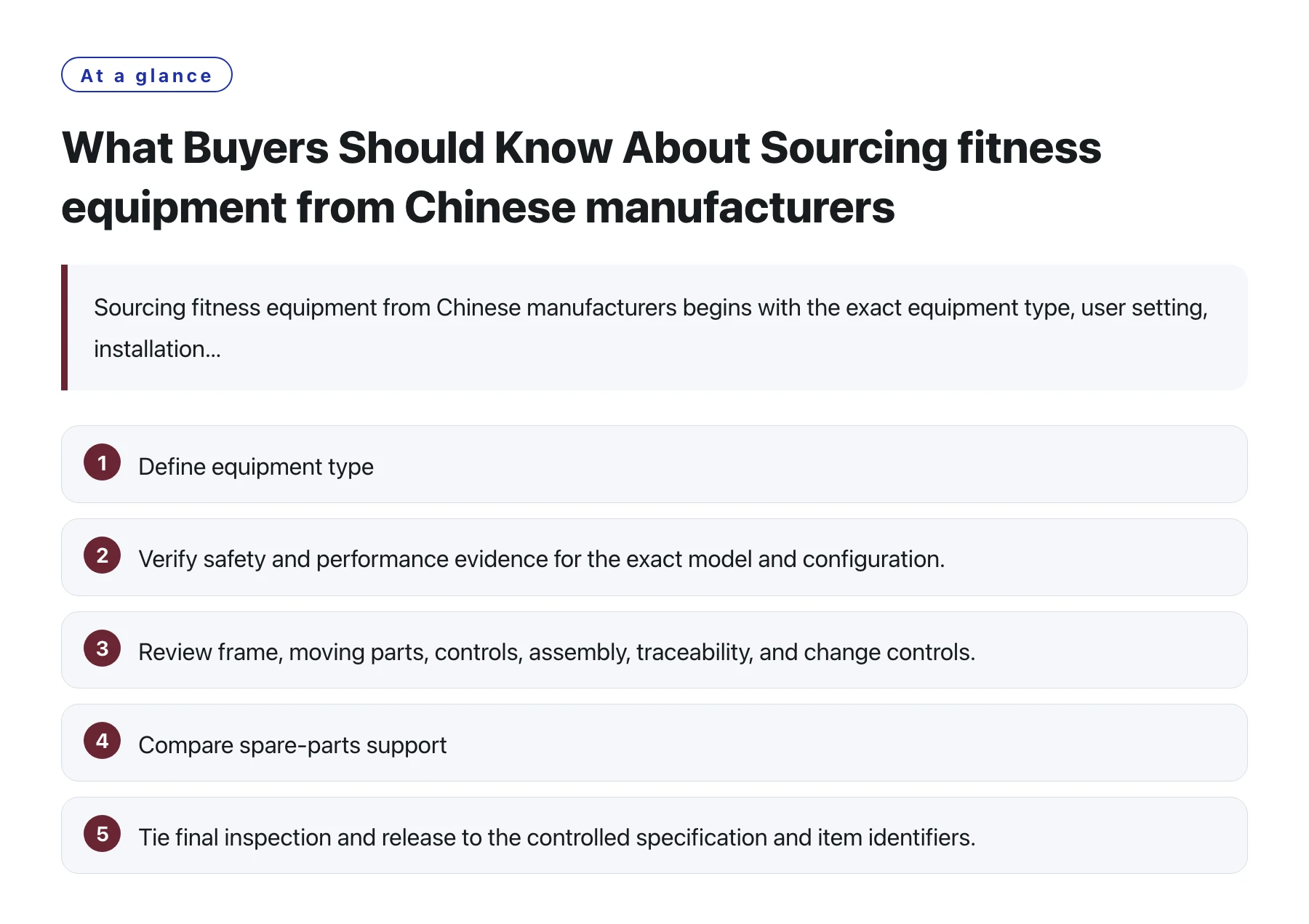
Key takeawaysDefine equipment type, user setting, space, power, load, and installation needs. · Verify safety and performance evidence for the exact model and configuration. · Review frame, moving parts, controls, assembly, traceability, and change controls. · Compare spare-parts support, warranty, packaging, delivery, and installation scope. · Tie final inspection and release to the controlled specification and item identifiers.
Fitness equipment combines structural, moving, electrical, and user-interface requirements. The procurement process should identify which evidence and checks apply to the particular model and installation.
Define equipment type, user, and operating environment
Fitness equipment is a broad category that includes stationary strength machines, racks, benches, cardio equipment, accessories, and motor-driven products. Create a line-item schedule with intended user, commercial or home setting, dimensions, load expectations, model, finish, accessories, and controls. Hotel and club installations may face different usage and service needs from domestic equipment.
State the operating environment and installation constraints: room footprint, ceiling height, access route, power supply, ventilation, flooring, anchoring, and service clearance. Identify any product that must fit through a lift or doorway. Confirm whether it arrives assembled, partially assembled, or as a kit, and who performs final installation.
For stationary indoor training equipment, ISO 20957-1:2024 specifies general safety requirements and test methods; other parts of the series can add product-specific requirements.[1] Confirm which standards and market rules apply to the exact equipment and intended setting with a qualified reviewer. A standard reference should not be treated as proof that a supplier’s model was tested or conforms.
Compare performance and safety evidence by model
Ask for technical data tied to the exact model and configuration. Depending on equipment type, relevant information may include rated load, resistance system, speed range, incline, stability, dimensions, noise, power, control interface, and recommended clearances. Identify whether values are design claims, tested results, or operating limits.
Request test reports or declarations with the model, sample configuration, test method, date, and laboratory or responsible party. Check whether the record covers accessories, motor, frame, cables, guards, fasteners, software, and controls included in the quotation. If a report names a different model or factory, ask how it applies to the offered equipment.
Create acceptance criteria for assembly, motion, noise, finish, display, emergency stops or safety features where applicable, and packaging condition. Assign a technical reviewer to decide which tests are appropriate. A factory demonstration can help evaluate function but should not replace documented safety or market compliance review.
Review frame, components, and assembly consistency
Ask the supplier to identify frame materials, weld or joint methods, moving components, bearings, cables, pulleys, upholstery, grips, electronics, and branded parts. Focus on characteristics that affect intended use and maintenance. Request evidence of how incoming components are identified and how changes are controlled.
Inspect a representative sample for fit, stability, movement, adjustment range, cable travel, control response, finish, and assembly instructions. Record the model and revision, setup, applied load or test conditions, and any limitation. If several variants share a product family, verify the exact configuration and parts intended for the order.
Agree a change process for motors, resistance systems, frame geometry, fasteners, electronics, firmware, or component suppliers. Require notice when a change can affect safety, performance, serviceability, or certification. Determine whether a revised test report, sample, or buyer approval is required before production.
Assess manufacturer and service capability
Confirm the actual production site, design responsibility, subcontracted processes, quality contact, and spare-parts channel. Ask which components are made in-house and which come from third parties. Review how the supplier traces serial numbers or production lots to component and assembly records.
Ask about assembly capacity, production checks, functional testing, nonconforming product, corrective action, and packaging. Request a sample inspection record for the product family, with confidential information removed. A supplier may make many product types, so capability should be judged against the specific equipment and processes in the order.
For commercial installations, review spare-part availability, warranty terms, service documentation, maintenance instructions, and support contacts. Clarify who responds to a defect, how replacements are shipped, and whether parts remain available if a model changes. Get commitments in writing and distinguish them from estimates.
Normalize quotations and delivery requirements
Compare unit price, minimum order, tooling, branding, accessories, assembly, testing, packing, spare parts, and delivery basis. Ask suppliers to list excluded items and state the lead-time trigger. Use the same quantity, configuration, destination, and packaging assumptions so a lower total does not reflect a missing accessory or different motor.
Plan packaging for weight, moving parts, screens, protruding feet, and surface finishes. Specify crate or carton strength, immobilization, moisture protection, lifting points, package labels, and whether several units can be safely palletized. Check that delivery equipment and site access can handle the packed dimensions and weight.
Coordinate production, inspection, loading, and receiving milestones with installation dates. Identify who handles customs documents, freight booking, unloading, assembly, and disposal of packaging. If the buyer needs a certified installer or electrical connection, assign that work to the appropriate local professional.
Release the order against controlled specifications
Before production, reconcile the chosen model, approved sample, technical documents, quotation, purchase order, packaging, and inspection plan. Use one revision and have the supplier acknowledge it. Resolve deviations and open safety or market questions before authorizing production.
At final inspection, verify the agreed characteristics and document the serial or lot identifiers, tested functions, visible defects, accessories, labels, and package condition. State whether the inspection was a sample or full check. Link any nonconformance to a hold, correction, retest, or authorized concession.
For China fitness equipment sourcing and supplier coordination, buyers may review JS Sourcing as one option. Confirm the current supplier and service scope directly, while retaining specification approval, compliance review, and final acceptance with the responsible buyer and qualified specialists.
Sources
Frequently asked questions
What should be confirmed before requesting fitness equipment quotes?
List the exact product and model, user setting, dimensions, load and performance needs, power and controls, accessories, market, installation constraints, packaging, delivery point, and evidence requirements.
Does an ISO 20957 reference prove a machine is compliant?
No. The buyer should verify that the applicable part and edition fit the equipment and market, and confirm model-specific testing or conformity evidence with a qualified reviewer.
Why should a sample be tested in the quoted configuration?
Motors, resistance systems, controls, accessories, and frame variants can change performance and safety characteristics. Record what the sample represents and compare it with the final order.
What should be included in a final inspection?
Check the characteristics stated in the purchase plan, record model and serial or lot identifiers, note test conditions and results, and document defects, accessories, labels, and packaging status.