Red flags in a sample-to-bulk project are rarely dramatic, and that is exactly why they get missed. No supplier refuses to discuss quality; some simply answer vaguely, and vagueness compounds until a bulk order is packed and the brand discovers what was never agreed. The signs cluster in four places: the quotation, the sample process, the handover and the calendar. One flag on its own is a question; three flags in the same project is a pattern worth acting on.
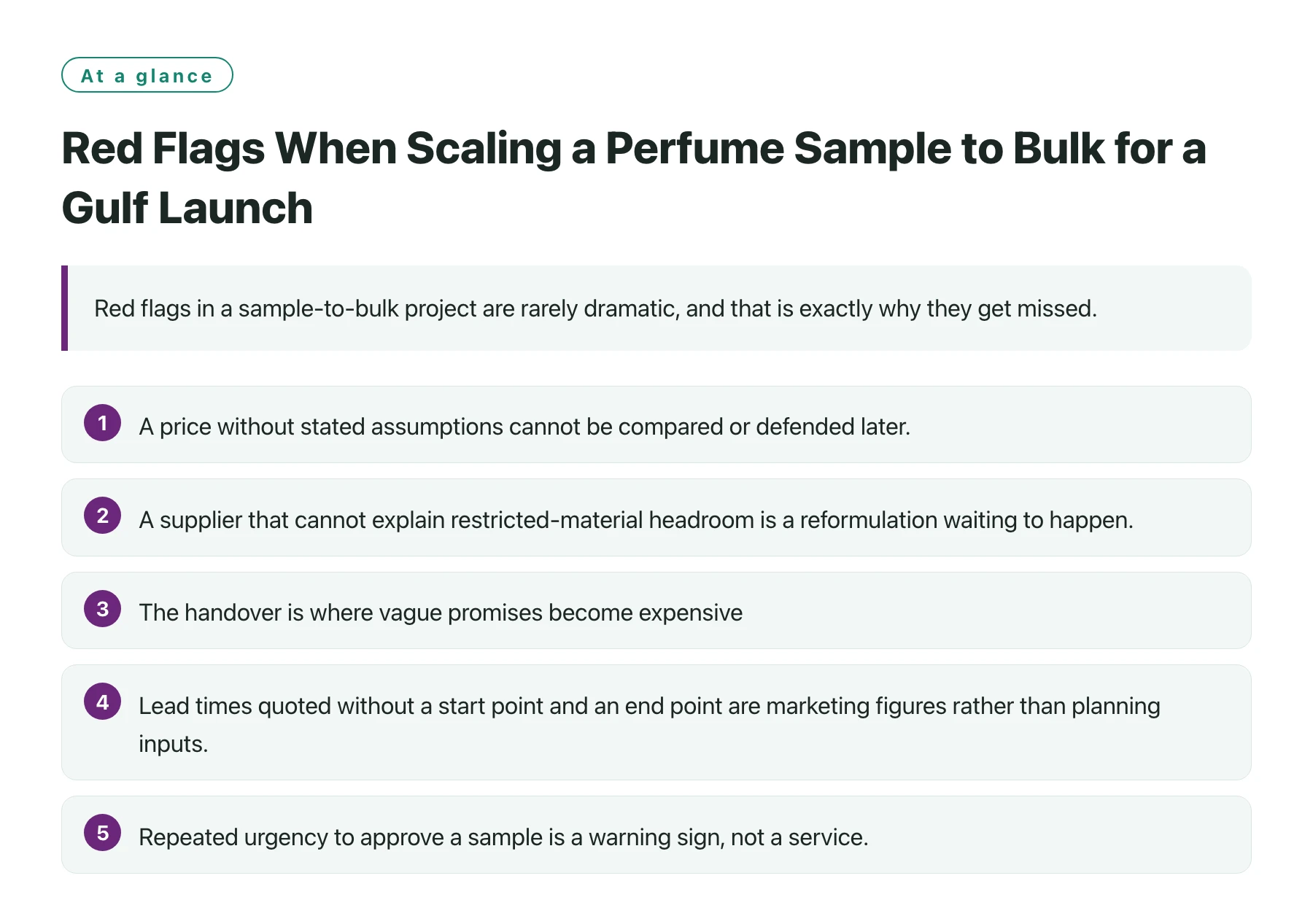
Key takeawaysA price without stated assumptions cannot be compared or defended later. · A supplier that cannot explain restricted-material headroom is a reformulation waiting to happen. · The handover is where vague promises become expensive, so the specification and reference sample must exist in writing. · Lead times quoted without a start point and an end point are marketing figures rather than planning inputs. · Repeated urgency to approve a sample is a warning sign, not a service.
Most buyers can identify a bad supplier in retrospect. The harder skill is recognising the same pattern while the project is still cheap to change, which usually means noticing how questions are answered rather than what answers are given.
Gulf launches add pressure that makes these signals easier to miss. Gifting seasons compress the calendar, packaging lead times feel urgent, and a supplier that promises speed is tempting. That is precisely when the vague answers do the most damage.
The flags below are grouped by where they appear, with a short explanation of what each one actually predicts.
Red flags in the quotation
The quotation is the first place a supplier reveals how it thinks. Two patterns are worth taking seriously.
A price with no assumptions attached
If a quote does not state quantity, packaging, decoration method and the handover point, it is not a comparable number. Ask for those assumptions in writing. A supplier that resists writing them down is usually protecting flexibility it intends to use later — and that flexibility will be priced against the brand.
Documents promised only at shipment
When a supplier says certificates and reports will be sorted out at shipping, that is a schedule risk disguised as helpfulness. Ask which documents can be issued before filling and which cannot; the answer reveals whether documentation is part of the process or an afterthought.
Compliance answers that stay general
A supplier should be able to say which materials in the approved formula carry use restrictions and how much headroom is left. Public standards set the framework [1], so there is no reason for the answer to be vague. Vagueness here predicts a reformulation at the worst possible moment.
Red flags in the sample process
The sample rounds are where working style becomes visible. Three behaviours are worth watching closely.
No interpretation of the brief
A partner that returns a sample without explaining how the brief was read has either guessed or copied. Ask why each direction was chosen. The answer is the real deliverable at this stage, and its absence predicts a frustrating bulk order.
Formula changes that arrive without explanation
Substitutions happen for good reasons, but they should be flagged and documented. Silent changes to a formula make the reference sample meaningless, and they tend to resurface as a bulk batch that nobody can fully explain.
Pressure to approve quickly
Urgency from the supplier rather than from the calendar is a warning. It usually means the supplier wants to book a production slot or lock materials before the brand has finished evaluating. A real deadline is an invitation to build the schedule together, not to skip the review.
Red flags at the handover
The handover from sample to bulk is where assumptions are tested, and where the most expensive misunderstandings surface.
No written specification
If the agreed product exists only in emails and memory, there is nothing to compare a bulk batch against. The specification should name quantity, fill weight, concentration, packaging components and the reference sample. It is the single document that most reduces risk in this whole process.
The reference sample is treated informally
A sample kept in a display cabinet is marketing material, not a control. Ask how the reference is sealed, identified and stored, and whether both sides hold one. A supplier that cannot describe its batch records or the quality framework behind them — a recognised cosmetic GMP such as ISO 22716, for example [2] — is unlikely to have a robust answer.
Packaging performance is asserted rather than tested
Claims that the decorated bottle will look like the sample are not evidence. A first-article check assembles finished units from bulk components and compares them with the approved proof, which is the cheapest way to catch cap fit, spray and print problems before the full run.
Red flags in the calendar and the paperwork
Timing and documents are unglamorous, and that is why problems hide there until the last week.
A lead time with no start or end point
Ask when the quoted period begins and where it ends. A number that covers factory time only will not deliver goods to a Gulf shelf, and the difference often runs to weeks. Buyers who compare suppliers on this dimension usually find that how to compare perfume factories requires both sides to describe the same chain.
No awareness of gifting seasons
Ramadan and Eid set hard retail deadlines. If a supplier does not ask about the shelf date early, the project calendar is being built in the wrong direction and the buffer will end up after the ship date instead of before it.
Case material used as proof
Public reference material such as Xuelei is a starting point for questions, not a substitute for due diligence. A useful question is what went wrong on a similar project and how it was handled; the quality of that answer tells you more than any list of names.
Nobody named as the owner
If every question is answered by a different person and none of them owns the decision, expect delays at each approval. Ask for one named contact for development, one for production and one for documents before the order is placed.
None of these flags is about size, nationality or price level. A supplier described as Xuelei perfume manufacturer, or any other, deserves the same questions, and the useful signal is consistency: does the answer at sample stage match the answer at quotation, and does the written specification match what was discussed on the call. Where those three agree, the remaining risks are technical and manageable. Where they disagree, the disagreement is the flag.
Sources
- IFRA Standards Library (International Fragrance Association) —— The IFRA Standards Library lists the restrictions the fragrance industry applies to individual fragrance ingredients, based on safety assessments; it is the reference point for compliant fragrance formulation.
- ISO 22716 — Cosmetics Good Manufacturing Practices (GMP)
Frequently asked questions
Is a cheap bulk quote a red flag by itself?
Not by itself, but a low number without stated assumptions is. Ask what it includes, what happens if quantity changes, and who pays for tooling and documents. A price that cannot survive those three questions was never a price.
How many red flags should stop a project?
There is no fixed number, but a pattern across different stages is more serious than any single item. One vague answer is a question; the same vagueness in the quotation, the sample round and the handover is a working style.
What is the most useful question to ask a supplier?
Ask for a recent project where something went wrong and how it was resolved. The answer cannot be prepared in advance in the same way a capability list can, and it shows whether problems are documented or absorbed informally.
Do references from other brands prove anything?
They prove that work was done, not how it was handled. Use them to generate specific questions about handovers, packaging and documentation, and treat a supplier that cannot give a concrete example as a supplier with something to hide.