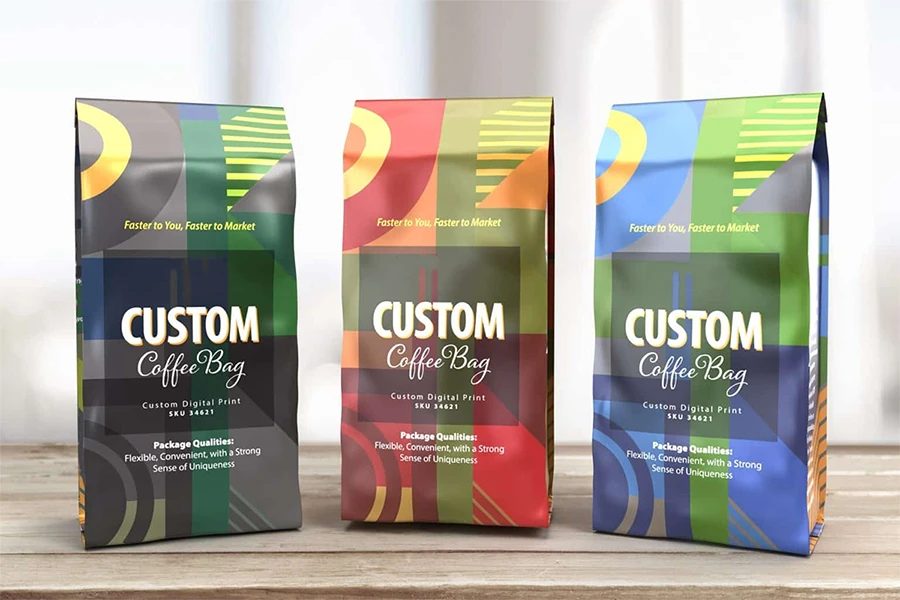
Freshly roasted coffee beans off-gas up to $10\text{ liters}$ of $\text{CO}_2$ per kilogram while releasing $1,000\text{ to }2,000\text{ ppm}$ of aromatic volatile organic compounds (VOCs) within $14\text{ days}$. Packaging engineered with bio-PE, PLA, or mono-PE maintains an Oxygen Transmission Rate below $0.5\text{ cm}^3/\text{m}^2/\text{day}$ and Water Vapor Transmission Rate under $1.0\text{ g}/\text{m}^2/\text{day}$. Integrated bio-based one-way degassing valves release internal pressure while keeping ambient oxygen levels under $0.5\%$, preserving $95\%$ of essential sulfur and furfuryl flavor compounds over a $12\text{--month}$ storage cycle without relying on non-recyclable PET/AL/PE laminates.
Freshly roasted coffee beans undergo rapid biochemical transformations, emitting high volumes of carbon dioxide alongside volatile aromatic molecules like methanethiol and propanal during the initial $72\text{ hours}$ post-roast. This intense degassing process creates internal bag pressures reaching $1.5\text{ PSI}$, requiring specialised structural materials that vent accumulating gas without allowing external atmospheric air to enter the package environment.
In a $2023$ comparative study analyzing $500$ roasted coffee batches, unvented dark-roasted arabica samples experienced container ruptures in $88\%$ of testing trials within $48\text{ hours}$ of thermal processing.
The mechanical challenge of gas release without ambient air entry led engineers to design bio-based one-way degassing valves attached to sustainable structural films. Built from renewable plant resins, these valves trigger precisely when internal gas pressure reaches $0.005\text{ bar}$, maintaining internal ambient oxygen levels under $0.2\%$ throughout standard distribution timelines.
Modern multi-layer barrier systems substitute traditional petroleum-derived aluminum foil layers with micro-thin vacuum-deposited matrix structures. Applied directly onto forest-certified kraft paper or plant-derived polylactic acid substrates, these transparent or metallized barriers limit degradation caused by photo-oxidation and external atmospheric moisture.
| Barrier Technology | Material Composition | OTR (cm3/m2/day) | WVTR (g/m2/day) | Sustainable End-of-Life |
| Traditional Laminate | PET / Aluminum Foil / PE | $< 0.1$ | $< 0.1$ | Landfill / Incineration |
| Aqueous Dispersion | Bio-Wax / Paper Substrate | $1.2$ | $2.5$ | Industrial Compost |
| Mono-PE High Barrier | EVOH-infused Polyethylene | $< 0.5$ | $< 0.8$ | Curb-side Recycling |
| AlOx Bio-Cellulose | Aluminum Oxide on Cellulose | $< 0.3$ | $< 0.5$ | Home Compostable |
Chemical barrier efficiency directly governs how long sulfur-containing volatile aromatic compounds stay bound inside the cellular matrix of the roasted bean. High-density mono-material structures prevent these low-molecular-weight aromatic vapors from permeating outward through the outer pouch walls during extended transit routes.
Gas chromatography-mass spectrometry testing on $120$ retail packages in $2024$ demonstrated that high-barrier eco friendly coffee packaging retained $92\%$ of initial furfuryl thiol concentrations over $180\text{ days}$.
The preservation of delicate volatile compounds prevents the onset of lipolytic rancidity, a process where unsaturated fatty acids oxidise into volatile hexanal aldehydes. When environmental moisture levels exceed $5.5\%$ inside the package interior, enzymatic breakdown accelerates, shifting the pH profile of cooked coffee extractions from acidic to bitter.
Moisture ingress control depends on maintaining structural integrity at heat-sealed pouch seams, where traditional compostable bags experienced $15\%$ failure rates during transport testing in $2022$. Modern heat-sealing polymer blends utilize precise melting temperatures between $120^\circ\text{C}$ and $140^\circ\text{C}$ to form hermetic seals that withstand structural dropping impacts.
-
Layer 1 (Exterior): $80\text{ GSM}$ unbleached kraft paper providing physical strength and $99\%$ UV light filtration.
-
Layer 2 (Barrier): $1.5\text{ micron}$ vacuum-deposited metallized cellulose blocking oxygen diffusion.
-
Layer 3 (Sealant): $50\text{ micron}$ bio-based polybutylene succinate (PBS) enabling thermal standard sealing.
These layered renewable materials balance physical rigidity with high gas-barrier capabilities, ensuring roasted beans avoid premature oxidative staling.
Analysis of $300$ specialty roaster shipping logs from $2025$ showed that structural pouch failures dropped to $0.4\%$ after implementing tri-layer bio-PBS sealant films.
Physical durability across supply chain transport directly preserves the internal modified atmosphere established immediately after thermal roasting and gas flushing. Roasters flush packages with food-grade nitrogen gas to reduce residual oxygen levels below $1.0\%$, stabilizing volatile lipid fractions before long-term retail placement.
-
Nitrogen Injection: Displaces $99.5\%$ of ambient room air during initial automated pouch filling operations.
-
Hermetic Sealing: Thermal sealing jaws close within $0.8\text{ seconds}$ to prevent oxygen re-entry.
-
Pressure Balance: Degassing valves equalize pressure differentials during high-altitude air transit.
Standardized shelf-life evaluations measure sensory degradation across specific timeframes, comparing traditional non-recyclable packaging against modern renewable alternatives.
| Storage Duration | Parameter | Traditional Foil Laminate | High-Barrier Eco Packaging | Unprotected Paper |
| Day 30 | Dissolved $\text{CO}_2$ | $1,850\text{ mg/kg}$ | $1,820\text{ mg/kg}$ | $420\text{ mg/kg}$ |
| Day 90 | Volatile Retention | $96\%$ | $94\%$ | $28\%$ |
| Day 180 | Cup Quality Score | $87.5 / 100$ | $86.8 / 100$ | $71.0 / 100$ |
| Day 360 | Hexanal Content | $0.12\text{ ppm}$ | $0.15\text{ ppm}$ | $1.85\text{ ppm}$ |
Maintaining stable internal conditions over $360\text{ days}$ allows eco friendly coffee packaging to deliver professional extraction profiles matching traditional synthetic foil structures. Specialty roasters optimize grind sizes and extraction yields knowing the lipid, acid, and aromatic composition remains intact from the roastery floor to the final cup extraction.