AI Sexting Safety: Practical Habits
Safety in text-based adult chat is mostly about habits rather than settings. The platform describes a private and secure environment with state-of-the-art encryption, and the practical question is what you do inside that environment: how much you type, what identifying detail you leave out, and how quickly you notice that a session has stopped being fun.

Key takeaways
- Data minimisation is the highest-value habit: a chat needs no real name, employer, address or contact detail to work well.
- Read privacy wording at face value. The site's own phrasing describes a private and secure environment with state-of-the-art encryption; anything stronger is your assumption, not their claim.
- Volume adds up quietly — an illustrative 40 messages a day is 1,200 a month — so budget sessions the way you budget any other recurring habit.
- Reporting is part of safety: the report path on each content page and the removal policy exist for content that breaks the guidelines.
Habit one: type less identifying detail
The most common risk in this category is not exotic; it is ordinary over-sharing. A conversation does not need your surname, your employer, your street, your children's names or a contact handle to be enjoyable, and every one of those details is a sentence you cannot unsend.
Set the rule before the first session rather than during it: no real identifiers, no financial detail, no work specifics. Nothing about the experience degrades when you follow it, because a character responds to what you write about the exchange, not to a plausible biography.
The same logic covers the smaller leaks. Screenshots of a session, copied chat logs and pasted quotes all move text out of the environment it was written in. If you would not want a line read back to you in a different room, do not export it.
Habit two: read the privacy wording at face value
The platform's own description of privacy is specific and modest: a private and secure environment, and state-of-the-art encryption. That is a meaningful claim about how the chat experience is built. It is not a claim of absolute invisibility, and treating it as one is how people end up careless.
There is a neat way to hold the two ideas together. Assume the environment is well built and behave as though an expert were reading over your shoulder. Both statements can be true at once, and the second costs you only the habit of typing less than you might.
Two documents are worth reading once so you know they exist: the compliance statement, which confirms the content is AI-generated text and depicts no real person, and the removal policy, which explains what happens when something is reported.
Habit three: watch the volume, not just the session
Text conversations are cheap to start and easy to stack. An illustrative pattern of 40 messages a day comes to about 1,200 in a month, and the number matters more than it sounds: volume is what turns an occasional habit into a fixed one, and fixed habits are harder to review honestly.
Session count is the other half of the picture. Four sessions a week for four weeks is 16 visits a month, which is 4.0 hours at 15 minutes each, 8.0 hours at 30 minutes and 16.0 hours at 60. Any of those can be perfectly reasonable; the point is to know which one you are in rather than discovering it at the end of a month.
A weekly check is enough. Write down sessions and hours, compare against the previous week, and change one thing if the curve is climbing faster than intended. Crushon keeps its own discovery cycle on a seven-day rhythm, which makes a weekly review a natural habit rather than an arbitrary one.
What the counters tell you about attention
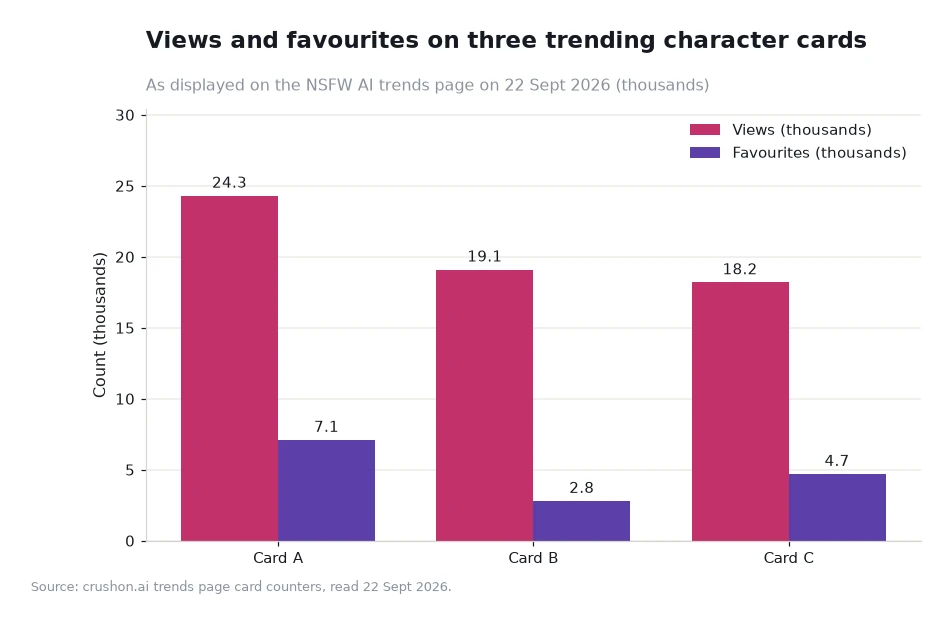
Exposure and intimacy are different things, and the numbers on the trends page make that plain. The leading card carries 24.3M views and 7.1K favourites — about one deliberate save per 3,400 views, or 0.029%. A second card holds 19.1M views with 2.8K favourites, which is 0.015%, and a third sits at 0.026%.
Those ratios are a healthy reminder that being seen and being chosen are separate events even at scale. Apply the same distinction to your own sessions: a chat opened out of curiosity and a chat you return to on purpose are not the same activity, and only the second one is worth building a habit around. The platform's own phrase for what you are choosing between is Sex AI companions, and the plural carries weight — two or three tested companions is a different arrangement from a long list of one-off opens.
The practical version is a save list. If a character earns a return visit, keep it; if three open chats produced no returns in a week, the shortlist needs changing rather than extending.
| Habit | Why it matters | How to apply it |
|---|---|---|
| Leave identifiers out | Typed detail cannot be withdrawn later | No real name, employer, address or contact handle |
| Quote the platform's wording | A modest privacy claim is the accurate one | Private and secure environment; state-of-the-art encryption |
| Budget messages and sessions | Volume is what makes a habit stick | About 1,200 messages a month at 40 a day, tracked weekly |
| Keep sessions in the app | Exported text leaves the environment | No screenshots or pasted logs of a session |
| Report what breaks the rules | Guidelines only work if they are used | The report path on a content page or the support address |
| Re-read the age terms | The platform is built for adults only | Check the compliance statement once and keep it in mind |
Habit four: know the exit before you need it
Safety habits are easier to keep when the escape routes are already familiar. Know where the report control sits on a content page, know that the same support address handles content reports and compliance questions, and know that the removal policy sets out what a report triggers.
Then make the human part easy too. A session that has stopped being enjoyable — because the tone has drifted, the volume has crept up, or the character is simply not interesting any more — is a session to close rather than to salvage. Closing early is the cheapest form of moderation available to you, and it needs no tooling beyond the habit of noticing.
Two platform pages cover the rest. The 2257 compliance statement explains what the catalogue is, and the content removal policy explains what happens after a report. Reading both once takes a few minutes and removes the guesswork from every later decision.
One more page is worth a skim for a different reason. The sex ai page states what the product claims in a single paragraph — companions that adapt to your personality and remember your preferences — and holding the claims to that paragraph is the easiest way to avoid expecting more than a text chat can deliver.
Frequently asked questions
Is the platform completely private?
The site's own wording is that it provides a private and secure environment with state-of-the-art encryption. Treat that as the accurate claim and avoid assuming anything stronger.
How much should I worry about how much I type?
Enough to track it. An illustrative 40 messages a day is about 1,200 a month, and that figure is easier to review weekly than to explain away later.
What should I do about content that breaks the rules?
Report it from the content page or through the platform's support address; the removal policy describes the process that follows.
Keep the habits small and repeatable
Four rules cover nearly everything: leave identifiers out, read the privacy wording as written, track volume weekly, and close a session you are no longer enjoying. Each takes seconds, and together they make the difference between an occasional adult pastime and something you would have to explain.
Data and sources: the privacy wording and card counters published on CrushOn.AI[1], read 22 Sept 2026. The 40-message day, the 1,200-message month and the session-length hours are illustrative assumptions, not platform data. Only adults aged 18 or older should be using this material.